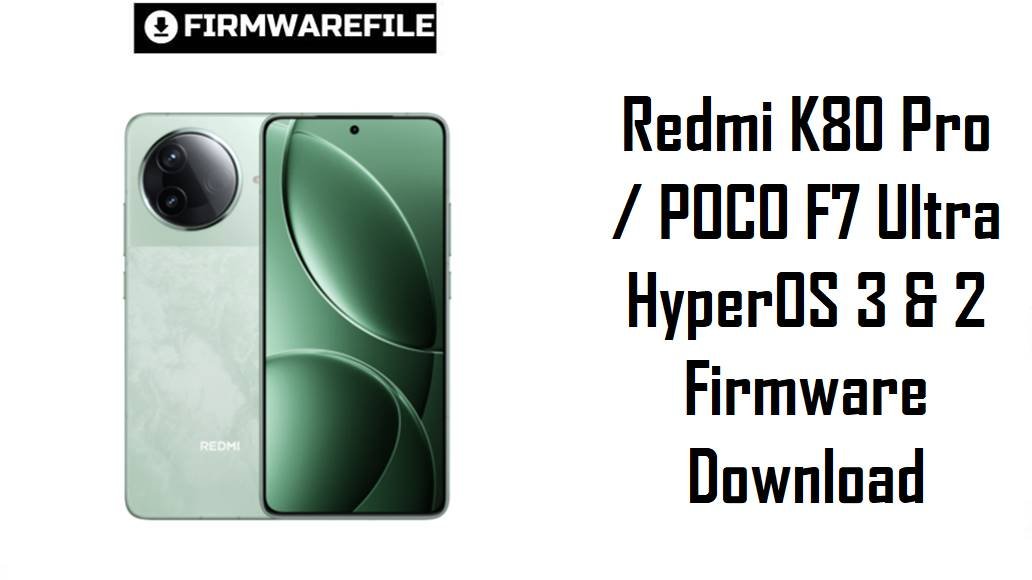
Redmi K80 Pro / POCO F7 Ultra HyperOS 3 & 2 Firmware Download
Redmi K80 Pro and POCO F7 Ultra bring flagship‑class hardware to Xiaomi’s upper tier, but early HyperOS builds triggered complaints about overheating, battery drain, RAM usage and random software bugs. These official HyperOS 3 (Android 16) and HyperOS 2 (Android 15) fastboot ROMs for codename miro let you clean‑flash region‑correct firmware to stabilize performance, fix update issues and take advantage of Xiaomi’s latest optimizations.
Download Firmware for Redmi K80 Pro / POCO F7 Ultra (miro)
All ROMs below are for devices with codename miro: Redmi K80 Pro (China/global) and POCO F7 Ultra in supported markets. Always match the region code in your current build (CNXM, MIXM, EUXM, RUXM, IDXM, TWXM, TRXM) to avoid network, OTA and anti‑rollback issues.
| Filename | Region / Variant | Build Number | Build Date | Android Version | Flashing Method | File Size | Notes | Download |
|---|---|---|---|---|---|---|---|---|
| miro_images_OS3.0.3.0.WOMCNXM_20251030.0000.00_16.0_cn_2b6533557d.tgz | China (Redmi K80 Pro, CNXM) | OS3.0.3.0.WOMCNXM | 2025‑10‑30 | Android 16.0 | Fastboot (Xiaomi Flash Tool) | 10.22 GB | Official China HyperOS 3 fastboot ROM; delivers Android 16 with the full HyperOS 3 visual refresh, smoother animations and power‑efficiency tweaks, but ships without Google services by default. | Download China Fastboot |
| miro_eea_global_images_OS3.0.3.0.WOMEUXM_20251024.0000.00_16.0_eea_d2011abbea.tgz | EEA / Europe (EUXM) | OS3.0.3.0.WOMEUXM | 2025‑10‑24 | Android 16.0 | Fastboot (Xiaomi Flash Tool) | 8.65 GB | Official HyperOS 3 EEA fastboot ROM for POCO F7 Ultra / Redmi K80 Pro; brings Android 16, revamped UI, better memory management and improved battery efficiency reported by early adopters. | Download EEA Fastboot |
| miro_global_images_OS2.0.204.0.VOMMIXM_20251016.0000.00_15.0_global_5441b10ee1.tgz | Global (MIXM) | OS2.0.204.0.VOMMIXM | 2025‑10‑16 | Android 15.0 | Fastboot (Xiaomi Flash Tool) | 9.01 GB | Latest Global HyperOS 2 fastboot ROM; changelog highlights October 2025 security patch, performance optimizations, improved memory allocation, smarter frequency scheduling and more efficient short‑video playback for better battery life. | Download Global Fastboot |
| miro_ru_global_images_OS2.0.206.0.VOMRUXM_20251013.0000.00_15.0_ru_5383d02a36.tgz | Russia (RUXM) | OS2.0.206.0.VOMRUXM | 2025‑10‑13 | Android 15.0 | Fastboot (Xiaomi Flash Tool) | 8.79 GB | Russia‑region HyperOS 2 build aligned with the same late‑2025 security baseline and performance tuning as other 2.0.20x firmware; best for Russian units that want stability without jumping to Android 16 yet. | Download Russia Fastboot |
| miro_id_global_images_OS2.0.205.0.VOMIDXM_20251016.0000.00_15.0_id_ae686818c8.tgz | Indonesia (IDXM) | OS2.0.205.0.VOMIDXM | 2025‑10‑16 | Android 15.0 | Fastboot (Xiaomi Flash Tool) | 8.40 GB | Indonesia‑specific HyperOS 2 fastboot ROM tuned for local carriers and regulations; recommended for Indonesian Redmi K80 Pro / POCO F7 Ultra to keep VoLTE and OTA working correctly. | Download Indonesia Fastboot |
| miro_tw_global_images_OS2.0.205.0.VOMTWXM_20251016.0000.00_15.0_tw_04e7521ad5.tgz | Taiwan (TWXM) | OS2.0.205.0.VOMTWXM | 2025‑10‑16 | Android 15.0 | Fastboot (Xiaomi Flash Tool) | 7.42 GB | Taiwan HyperOS 2 fastboot ROM; shares the October 2025 patch and performance/battery optimizations described for this branch, tailored to Taiwanese networks and compliance. | Download Taiwan Fastboot |
| miro_tr_global_images_OS2.0.101.0.VOMTRXM_20250407.0000.00_15.0_tr_6e0c22f37f.tgz | Turkey (TRXM) | OS2.0.101.0.VOMTRXM | 2025‑04‑07 | Android 15.0 | Fastboot (Xiaomi Flash Tool) | 8.04 GB | Early HyperOS 2 Turkey fastboot ROM; considerably older than the 2.0.20x family and missing later optimizations, so flash only if you specifically need this version for downgrade or recovery on Turkish units. | Download Turkey Fastboot |
| xiaomi.eu_MIRO_OS3.0.3.0.WOMCNXM_16.zip | Custom EU ROM (based on China WOMCNXM) | OS3.0.3.0.WOMCNXM (xiaomi.eu) | 2025‑11 (community release) | Android 16.0 | Fastboot script / custom recovery | 7.46 GB | Community‑built xiaomi.eu ROM derived from China HyperOS 3.0.3.0.WOMCNXM with added languages, Google services and extra tweaks; requires unlocked bootloader and is not an official Xiaomi release. | Download xiaomi.eu ROM |
For everyday users, the safest option is the fastboot ROM that matches your original region (MIXM, EUXM, CNXM, etc.), while the xiaomi.eu build is aimed at advanced users who already understand bootloader unlocking and custom ROM risks.
Complete Device & Firmware Overview
- Device Names
- Redmi K80 Pro (China/global) and POCO F7 Ultra (selected markets) share the same core hardware and codename miro.
- Codename
- miro — must match in fastboot mode and firmware filenames before flashing any ROM on this page.
- Regions / Variants
- China (CNXM), Global (MIXM), EEA (EUXM), Russia (RUXM), Indonesia (IDXM), Taiwan (TWXM), Turkey (TRXM), plus community xiaomi.eu builds based on the China branch.
- Chipset Class
- Flagship‑level 5G SoC paired with high‑refresh‑rate display and performance‑focused tuning, enabling demanding gaming and camera workloads but also amplifying heat and battery issues on poor firmware.
- Firmware Types
- Official HyperOS 3.0 (Android 16) fastboot ROMs for China and EEA, official HyperOS 2.0 (Android 15) fastboot ROMs for remaining regions, and an unofficial xiaomi.eu HyperOS 3 ROM.
- Security Patch Level
- HyperOS 2.0.204.0 and 2.0.205.0 builds list the October 2025 Android security patch with increased system security, while HyperOS 3 builds arrive later in 2025 with further updates.
- Key User Pain Points
- Owners report overheating, fast battery drain, HyperOS bugs (crashing tiles, missing AI features), UI lag and connectivity quirks, especially on early HyperOS 2 releases.
- What These Updates Improve
- Changelogs and user feedback highlight refined compiler instructions, better memory recovery, smarter CPU scheduling, smoother animations and improved power efficiency, while HyperOS 3 adds a UI overhaul and further battery/performance gains.
- Flash Methods
- All official TGZ packages are fastboot ROMs flashed on a Windows PC with Xiaomi’s fastboot tools; the xiaomi.eu ZIP comes with its own fastboot scripts or requires a custom recovery.
- Bootloader Rules
- Manual fastboot flashing and xiaomi.eu ROMs require an unlocked bootloader; relocking on a mismatched region or custom ROM can cause boot loops or loss of network.
- Required Tools
- Windows PC, Xiaomi USB drivers, Xiaomi Flash Tool (or equivalent fastboot flasher), good USB‑C cable and checksum verification for each ROM; xiaomi.eu ROMs additionally require bootloader unlock approval and comfort with fastboot scripts.
Flashing the wrong region, a corrupted archive or a ROM for a different codename can permanently brick your Redmi K80 Pro / POCO F7 Ultra or break connectivity, so always verify miro, the exact region suffix and file integrity before you proceed.
CRUCIAL WARNING: These ROMs are strictly for Redmi K80 Pro / POCO F7 Ultra with codename miro; do not flash them to other Xiaomi / Redmi / POCO models or different codenames, because cross‑flashing can hard‑brick the device.
Each build is region‑locked by code (WOMCNXM, WOMEUXM, VOMMIXM, VOMRUXM, VOMIDXM, VOMTWXM, VOMTRXM), so normally you should use the ROM that matches your phone’s original region and avoid cross‑region flashing unless you fully understand anti‑rollback and modem differences.
All official miro_*.tgz fastboot packages wipe user data when flashed, and selecting options like “clean all and lock” on a mismatched or custom ROM can relock the bootloader and cause boot or network failures.
Preparation Before Flashing
Click here for the Redmi K80 Pro / POCO F7 Ultra pre‑flash checklist
- Confirm codename and region: In fastboot mode, check that the device reports miro, then read your current build (MIXM, EUXM, CNXM, etc.) in Settings > About phone > HyperOS version before picking a ROM.
- Backup everything important: Fastboot flashes fully rebuild system partitions and erase user data; back up apps, media and settings to Xiaomi Cloud, Google or a PC.
- Charge sufficiently: Keep at least 50–60% battery to avoid shutdown mid‑flash, which can corrupt partitions and leave the phone unbootable.
- Install drivers and tools: On your Windows PC, install Xiaomi USB drivers and Xiaomi Flash Tool (or similar), then confirm the device is detected in fastboot mode before flashing.
- Check bootloader & ARB: Make sure the bootloader is unlocked for fastboot or xiaomi.eu installs, and avoid downgrading below your device’s anti‑rollback index to prevent ARB errors.
Quick Firmware Flash Instructions
Below are simplified steps for flashing official fastboot ROMs and the xiaomi.eu build; follow a full Xiaomi fastboot guide if you are new to these tools.
Official fastboot ROMs (all miro_…images_…tgz)
- Prepare PC and ROM: Install Xiaomi USB drivers and Xiaomi Flash Tool, then download and extract the chosen miro_…images_… TGZ (for example OS3.0.3.0.WOMEUXM or OS2.0.204.0.VOMMIXM) to a short folder path like C:\miro_rom.
- Enter fastboot: Power off the phone, hold Volume Down + Power until the fastboot screen appears, then connect it to the PC via a reliable USB‑C cable.
- Load the ROM: Open Xiaomi Flash Tool, click to select the extracted ROM folder and confirm the device appears in the device list.
- Flash safely: Choose a “clean all”‑type option (to wipe data but keep the bootloader unlocked), click the flash button and wait for the green success status without disconnecting the phone.
- First boot & checks: Let HyperOS boot and finish optimization (this can take several minutes), then check About phone to verify the codename miro, region code and build number match the ROM you flashed.
xiaomi.eu_MIRO_OS3.0.3.0.WOMCNXM_16.zip (advanced users)
- Unlock bootloader first: Apply for bootloader unlock through Xiaomi’s official process and proceed only after confirmation, understanding that this wipes the device.
- Download and extract: Grab the xiaomi.eu MIRO_OS3.0.3.0.WOMCNXM_16.zip, then extract it on your PC to access the included fastboot scripts.
- Enter fastboot mode: Boot the phone into fastboot and connect to the PC with working drivers, similar to the official ROM method.
- Run the script: Use the appropriate fastboot script from the extracted xiaomi.eu folder (usually a windows_fastboot_*.bat) and follow on‑screen prompts to flash all partitions.
- Let the ROM settle: First boot can be long; after setup, give HyperOS 3 a few days of normal use for battery and performance statistics to stabilize.
For a detailed, screenshot‑rich walkthrough of Xiaomi fastboot flashing (drivers, errors, anti‑rollback checks), follow the main Xiaomi fastboot firmware guide and simply select the appropriate miro_*.tgz folder when prompted.
Frequently Asked Questions (FAQs)
- Q1. Which ROM should I pick for my Redmi K80 Pro / POCO F7 Ultra?
- The safest choice is always the fastboot ROM that matches your phone’s original region code, such as OS2.0.204.0.VOMMIXM for Global, OS3.0.3.0.WOMEUXM for EEA, OS3.0.3.0.WOMCNXM for China, or the corresponding VOMRUXM / VOMIDXM / VOMTWXM / VOMTRXM for Russia, Indonesia, Taiwan and Turkey.
- Q2. Is HyperOS 3 (Android 16) worth it over HyperOS 2 for EEA/China?
- Reports on HyperOS 3 for POCO F7 Ultra highlight a refreshed UI, smoother animations, improved memory management and better battery life, so most users on EEA or China channels will benefit from moving to OS3.0.3.0 when available for their region.
- Q3. Will these updates fix overheating and battery drain?
- HyperOS bug reports and community guides stress that newer builds with updated security patches and scheduler/memory optimizations significantly reduce abnormal heat and drain compared with earlier firmware, especially after a clean flash and basic tuning.
- Q4. What is the difference between China WOMCNXM, EEA WOMEUXM and xiaomi.eu?
- China WOMCNXM offers Android 16 earliest but only Chinese/English and no Google services, EEA WOMEUXM adds full European localization and Google integration, while xiaomi.eu builds customize the China base with extra languages, GApps and tweaks but are unofficial.
- Q5. Can I cross‑flash Global or China firmware on my EEA or Russian device?
- Advanced users sometimes cross‑flash, but community experience and Xiaomi’s region‑locked structure show that mixing regions can affect modem configuration, OTA eligibility and bootloader status, so average users should stay on their own region’s ROM.
- Q6. Why is bootloader unlocking such a big deal on POCO F7 Ultra?
- Reviews mention strict unlock policies and low approval chances, and because fastboot and xiaomi.eu installs require an unlocked bootloader, many users are effectively limited to OTA updates unless they are accepted into Xiaomi’s unlock program.