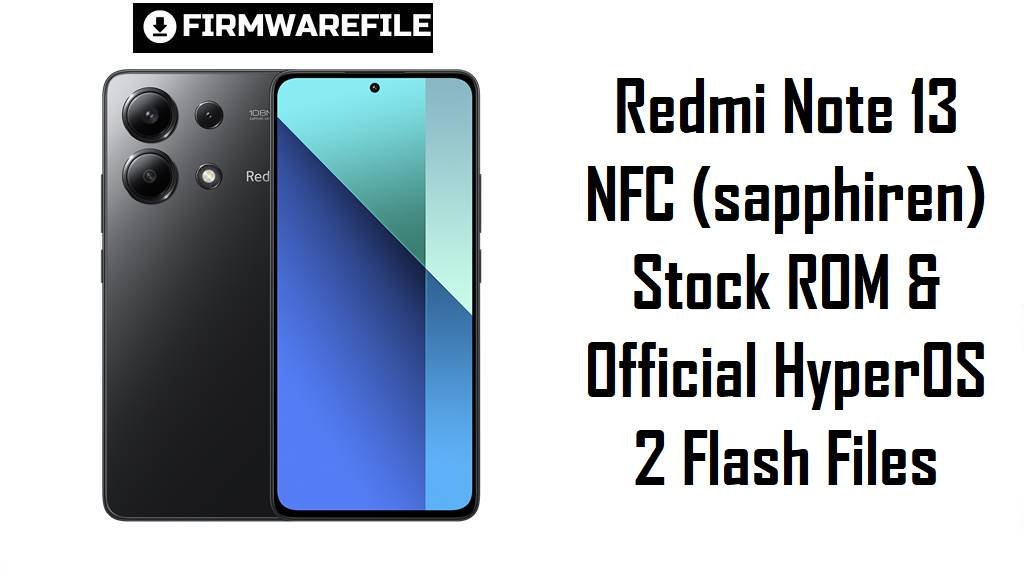
Redmi Note 13 NFC (sapphiren) Stock ROM & Official HyperOS 2 Flash Files
Redmi Note 13 4G NFC (codename sapphiren) is the NFC‑enabled variant of the Redmi Note 13 4G, sharing a 6.67‑inch AMOLED 120 Hz display, Snapdragon 685 chipset, up to 8 GB RAM and a 5000 mAh battery with 33 W charging. While its 108 MP main camera and bright screen earn positive reviews, users note that background app reloads, modest battery endurance and occasional HyperOS lag can appear after OTAs, especially on devices with 6 GB RAM.
The official HyperOS 2 Android 15 fastboot ROMs and Xiaomi.eu custom ROM below for sapphiren let you clean‑flash stable firmware, repair soft bricks and align your device with the latest regional updates.
Download Firmware Flash File for Redmi Note 13 4G NFC
These are official and community HyperOS 2 Android 15 ROMs for Redmi Note 13 4G NFC (codename sapphiren), covering Global, EEA, Indonesia, Russia, Taiwan and Turkey regions. All OS2.0.20x VNH*** builds listed here date from late 2025 and are current stable releases across their respective regions.
| Filename | Region / Variant | Build Number | Build Date | Android Version | Flashing Method | File Size | Notes | Download |
|---|---|---|---|---|---|---|---|---|
| sapphiren_global_images_OS2.0.206.0.VNHMIXM_20251103.0000.00_15.0_global_ab8bdec2d9.tgz | Global – Redmi Note 13 4G NFC Global | OS2.0.206.0.VNHMIXM | 2025‑11‑03 | Android 15 (HyperOS 2 Global) | Fastboot (Xiaomi Flash Tool) | 7.03 GB | Latest Global HyperOS 2 fastboot ROM for sapphiren; HyperOS trackers list OS2.0.206.0.VNHMIXM as the newest stable Android 15 Global build, bringing November 2025 security patches and system stability enhancements. | Download from Xiaomi |
| sapphiren_eea_global_images_OS2.0.207.0.VNHEUXM_20251107.0000.00_15.0_eea_4f43298236.tgz | EEA / Europe – Redmi Note 13 4G NFC EU | OS2.0.207.0.VNHEUXM | 2025‑11‑07 | Android 15 (HyperOS 2 EEA) | Fastboot (Xiaomi Flash Tool) | 6.58 GB | Latest EEA HyperOS 2 fastboot ROM; firmware archives show OS2.0.207.0.VNHEUXM as the current EEA build for sapphiren, with EU regulatory compliance and regional network optimization. | Download from Xiaomi |
| sapphiren_id_global_images_OS2.0.207.0.VNHIDXM_20251107.0000.00_15.0_id_b883293850.tgz | Indonesia – Redmi Note 13 4G NFC ID | OS2.0.207.0.VNHIDXM | 2025‑11‑07 | Android 15 (HyperOS 2 Indonesia) | Fastboot (Xiaomi Flash Tool) | 6.58 GB | Indonesia‑region fastboot ROM; Indonesian firmware indexes list OS2.0.207.0.VNHIDXM as a late‑2025 VNHIDXM stable, replacing earlier OS2.0.20x builds. | Download from Xiaomi |
| sapphiren_ru_global_images_OS2.0.209.0.VNHRUXM_20251107.0000.00_15.0_ru_8fa811bc8c.tgz | Russia – Redmi Note 13 4G NFC RU | OS2.0.209.0.VNHRUXM | 2025‑11‑07 | Android 15 (HyperOS 2 Russia) | Fastboot (Xiaomi Flash Tool) | 7.23 GB | Russian HyperOS 2 fastboot ROM; OS2.0.209.0.VNHRUXM is the highest numbered VNHRUXM release for sapphiren, recommended over OS2.0.208 or older for Russian units. | Download from Xiaomi |
| sapphiren_tw_global_images_OS2.0.207.0.VNHTWXM_20251107.0000.00_15.0_tw_790b3e13ef.tgz | Taiwan – Redmi Note 13 4G NFC TW | OS2.0.207.0.VNHTWXM | 2025‑11‑07 | Android 15 (HyperOS 2 Taiwan) | Fastboot (Xiaomi Flash Tool) | 5.55 GB | Taiwan‑specific fastboot ROM; TW firmware sites show OS2.0.207.0.VNHTWXM as a stable Android 15 build for sapphiren devices sold in Taiwan. | Download from Xiaomi |
| sapphiren_tr_global_images_OS2.0.207.0.VNHTRXM_20251107.0000.00_15.0_tr_00a54acfac.tgz | Turkey – Redmi Note 13 4G NFC TR | OS2.0.207.0.VNHTRXM | 2025‑11‑07 | Android 15 (HyperOS 2 Turkey) | Fastboot (Xiaomi Flash Tool) | 6.39 GB | Turkey‑region HyperOS 2 fastboot ROM; OS2.0.207.0.VNHTRXM is listed as the current Turkish Android 15 stable for sapphiren. | Download from Xiaomi |
| xiaomi.eu_SAPPHIREN_OS2.0.206.0.VNHMIXM_15.zip | Xiaomi.eu custom ROM based on Global OS2.0.206.0 | OS2.0.206.0.VNHMIXM (Xiaomi.eu) | Based on 2025‑11‑03 Global build | Android 15 (HyperOS 2, debloated) | Recovery (TWRP / custom recovery) | 4.70 GB | Community multi‑language ROM built from the Global OS2.0.206.0.VNHMIXM firmware, with removed ads/bloat and additional tweaks; some users report smoother performance than stock, while others mention HyperOS‑wide battery concerns. | Download from SourceForge |
Choosing the right ROM: For most users, the safest bet is the newest official build that matches your region suffix (VNHMIXM for Global, VNHEUXM for EEA, VNHIDXM for ID, VNHRUXM for RU, VNHTWXM for TW, VNHTRXM for TR); the Xiaomi.eu ZIP targets experienced users comfortable with custom recovery.
Complete Device & Firmware Overview
- Device & codename
- Redmi Note 13 4G NFC is internally identified as codename sapphiren in Xiaomi firmware databases, distinguishing it from the non‑NFC sapphire variant.
- Model numbers
- Typical model codes for sapphiren include 23124RA7EO (Global NFC variant) and related numbers; GSMArena and PhoneDB also list 23129RAA4G and 23129RA5FL, though these may overlap with non‑NFC variants.
- Display
- The phone uses a 6.67‑inch AMOLED at 1080×2400, 120 Hz and 1800 nits peak brightness with Gorilla Glass 3 protection.
- Chipset & memory
- It runs Snapdragon 685 (6 nm) with Adreno 610 GPU, paired with 6 or 8 GB LPDDR4X RAM and 128–512 GB UFS 2.2 storage with microSD expansion.
- Cameras
- The rear triple setup is headlined by a 108 MP main sensor (f/1.8, PDAF), flanked by an 8 MP ultrawide and a 2 MP macro, while the front has a 16 MP selfie camera capable of 1080p 30 fps video.
- Battery & charging
- A 5000 mAh battery supports 33 W wired charging, which Xiaomi rates at roughly 50% in 29 minutes; real‑world tests and user reports note moderate endurance, with standby drain sometimes higher than expected on HyperOS builds.
- NFC & connectivity
- The key differentiator of sapphiren is the inclusion of NFC (market‑dependent), plus IR blaster, dual‑band Wi‑Fi 5, Bluetooth 5.1 and USB‑C 2.0 with OTG.
- Software & updates
- The device launched on stock Android 13 with MIUI 14, has received Android 14 HyperOS 1 (OS1.0.x UNH***) and is now on Android 15 HyperOS 2 via OS2.0.20x VNH*** builds, with up to three major Android upgrades promised.
- Common issues
- Users on Reddit and XDA report noticeable battery drain after moving to HyperOS 2, especially with 6 GB RAM variants where background reloads can increase power use, echoing broader HyperOS‑wide battery complaints.
- How these ROMs help
- Clean‑flashing the latest regional fastboot ROM resets leftover OTA layers, applies November 2025 security patches and reindexes the system, often stabilizing battery behavior and reducing lag on the Snapdragon 685.
- Firmware types
- The Xiaomi packages here are official .tgz fastboot ROMs for flashing via PC, while the Xiaomi.eu ZIP is a community custom ROM flashed via custom recovery.
- Bootloader & anti‑rollback
- Manual fastboot and Xiaomi.eu flashes require an unlocked bootloader, and Xiaomi’s anti‑rollback can brick devices if you downgrade beyond allowed OS2.0.x levels.
- Tools needed
- You need a Windows PC, Xiaomi USB drivers, Xiaomi Flash Tool (for fastboot ROMs), a reliable USB‑C cable.
CRUCIAL WARNING: These ROMs are strictly for Redmi Note 13 4G NFC with codename sapphiren; do not flash them to non‑NFC Redmi Note 13 4G (sapphire), Redmi Note 13 5G, POCO M6 Plus or any other models, because cross‑flashing can permanently brick the device.
Each build is region‑locked by its suffix (VNHMIXM, VNHEUXM, VNHIDXM, VNHRUXM, VNHTWXM, VNHTRXM), so you should normally flash the ROM that matches your phone’s original region and avoid unnecessary cross‑region or major downgrade flashing while anti‑rollback is enabled.
All official sapphiren_*.tgz fastboot packages wipe user data when flashed, and choosing aggressive options like “clean all and lock” with a mismatched region can relock the bootloader on unsupported firmware and cause boot loops, lost NFC/IR functions or difficulty unlocking again.
Preparation Before Flashing
Click here for the Redmi Note 13 4G NFC pre‑flash checklist
- Confirm codename & region: Boot to fastboot mode and run fastboot getvar product on your PC; continue only if it returns sapphiren, then check Settings → About phone for your region suffix (VNHMIXM, VNHEUXM, VNHIDXM, VNHRUXM, VNHTWXM, VNHTRXM).
- Match the correct ROM: Download the fastboot ROM whose suffix exactly matches your current build; only advanced users with recovery plans should consider the Xiaomi.eu custom ROM.
- Backup your data: Fastboot and custom ROM flashes erase apps, media and settings, so back up via Google, Xiaomi Cloud or a PC before starting.
- Charge the phone: Ensure at least 50–60% battery to avoid shutdown during the flash; the 33 W charger can bring it up quickly if needed.
- Install drivers & tools: On Windows, install Xiaomi USB drivers and Xiaomi Flash Tool for fastboot ROMs; for Xiaomi.eu, also prepare a working custom recovery.
Quick Firmware Flash Instructions
This section gives short, high‑level steps for flashing the official fastboot ROMs and the Xiaomi.eu custom ROM without going into deep technical detail.
A. Official HyperOS 2 fastboot ROMs (all sapphiren_*.tgz)
- Prepare PC & ROM: On Windows, install Xiaomi USB drivers and Xiaomi Flash Tool, then download and fully extract your chosen sapphiren_…images_OS2.0.20x.0.VNH* .tgz into a short folder path such as C:\sapphiren_rom.
- Enter fastboot: Power off the phone, hold Volume Down + Power until the fastboot logo appears, then connect it to the PC with a reliable USB‑C cable.
- Select ROM in MiFlash: Open Xiaomi Flash Tool, click “Select” and choose the extracted ROM folder, then click “Refresh” and confirm one sapphiren device is detected.
- Flash with “clean all”: Choose the “clean all” option (wipes data, keeps bootloader unlocked), click “Flash” and wait for the success status without disconnecting the phone.
- First boot & checks: Let HyperOS 2 boot and finish optimization, then open About phone to verify codename, region suffix and build number match the ROM you installed.
B. Xiaomi.eu_SAPPHIREN_OS2.0.206.0.VNHMIXM_15.zip (custom ROM)
- Unlock & install recovery: After unlocking the bootloader, boot or install a compatible custom recovery (such as TWRP) for sapphiren.
- Copy the ZIP: Download the Xiaomi.eu ZIP and copy it to your phone’s internal storage or sideload location.
- Boot to recovery: Use the key combo or adb reboot recovery to enter custom recovery.
- Wipe & flash: In recovery, wipe data (as recommended by the ROM maintainer), then select and flash the Xiaomi.eu ZIP, waiting until it completes without error.
- Reboot & set up: Reboot to system, complete initial setup and confirm HyperOS 2 and the expected Xiaomi.eu build number in About phone.
For detailed, screenshot‑rich instructions on Xiaomi fastboot flashing, follow the main Xiaomi fastboot firmware guide, and for custom ROM installation follow the Xiaomi.eu documentation for sapphiren.
Frequently Asked Questions (FAQs)
- Q1. Which stock ROM here is best for my Redmi Note 13 4G NFC?
- The safest choice is the newest official build that matches your suffix: OS2.0.206.0.VNHMIXM for Global, OS2.0.207.0.VNHEUXM for EEA, OS2.0.207.0.VNHIDXM for ID, OS2.0.209.0.VNHRUXM for RU, OS2.0.207.0.VNHTWXM for TW or OS2.0.207.0.VNHTRXM for TR.
- Q2. Can these ROMs fix my battery drain and lag on Redmi Note 13 4G NFC?
- Many standby‑drain issues come from buggy services and leftover data after OTAs; a clean flash of the latest HyperOS 2 ROM often normalizes background activity and battery consumption, though 6 GB RAM variants may still reload apps more frequently.
- Q3. Is the Xiaomi.eu custom ROM better than stock for performance and battery?
- Xiaomi.eu removes ads and bloat and can feel smoother, but HyperOS‑wide issues like drain or background reindexing can still appear, so it is not a guaranteed fix and relies on community support rather than Xiaomi.
- Q4. Can I use a sapphire (non‑NFC) ROM on my sapphiren device or vice versa?
- No; sapphire and sapphiren have slightly different hardware (NFC module) and firmware partitions, so cross‑flashing risks boot loops or lost NFC functionality—always match your exact codename.
- Q5. Will these ROMs upgrade my phone to Android 16 or HyperOS 3?
- No; OS2.0.20x VNH*** builds are Android 15 HyperOS 2, and Android 16 / HyperOS 3 for sapphiren would arrive later as OS3.0.x or equivalent when Xiaomi begins that rollout.
- Q6. Do I need to unlock the bootloader to flash these ROMs?
- Yes, Xiaomi’s standard fastboot flashing and Xiaomi.eu installation both require an unlocked bootloader, and the unlock process itself wipes user data, so always back up beforehand.