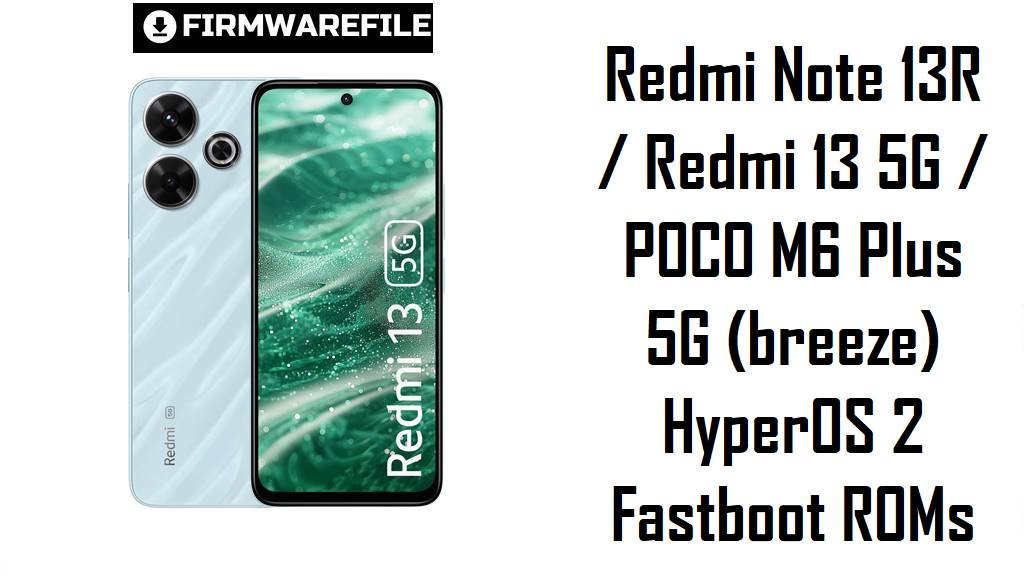
Redmi Note 13R / Redmi 13 5G / POCO M6 Plus 5G (breeze) HyperOS 2 Fastboot ROMs
Redmi 13 5G, POCO M6 Plus 5G and Redmi Note 13R share the same “breeze” platform, combining a 6.79‑inch 120 Hz LCD, Snapdragon 4 Gen 2 (or 4+ Gen 2) chipset and 5030 mAh battery in the budget 5G segment.
The official HyperOS 2 Android 15 fastboot ROMs below for codename breeze let you clean‑flash late‑2025 firmware for China and India, fix broken OTAs and give the phone a fresh, optimized software base.
Download Firmware for Redmi 13 5G / POCO M6 Plus 5G
These files are official HyperOS 2 (Android 15) fastboot ROMs for devices with codename breeze: Redmi 13 5G, POCO M6 Plus 5G and Redmi Note 13R, covering China and India. Both OS2.0.204.0 builds are newer than earlier OS2.0.203.0 firmwares listed on HyperOS update sites, so they are the preferred clean‑flash choice for their regions unless an even higher OS2.0.20x version is released later.
| Filename | Region / Variant | Build Number | Build Date | Android Version | Flashing Method | File Size | Notes | Download |
|---|---|---|---|---|---|---|---|---|
| breeze_images_OS2.0.204.0.VNUCNXM_20251030.0000.00_15.0_cn_b0e31f2360.tgz | China – Redmi Note 13R / Redmi 13 5G CN | OS2.0.204.0.VNUCNXM | 2025‑10‑30 | Android 15 (HyperOS 2, China) | Fastboot (Xiaomi Flash Tool) | 7.40 GB | Latest China HyperOS 2 fastboot ROM for breeze; firmware trackers and OTA archives show OS2.0.204.0.VNUCNXM as a late‑2025 stable update above OS2.0.203.0, bundled as both recovery ZIP and fastboot TGZ for deep repairs. | Download from Xiaomi |
| breeze_in_global_images_OS2.0.204.0.VNUINXM_20251103.0000.00_15.0_in_71989a470e.tgz | India Global – Redmi 13 5G / POCO M6 Plus 5G IN | OS2.0.204.0.VNUINXM | 2025‑11‑03 | Android 15 (HyperOS 2, India) | Fastboot (Xiaomi Flash Tool) | 6.70 GB | India fastboot ROM for breeze; HyperOS trackers previously listed OS2.0.3.0.VNUINXM, and OS2.0.204.0.VNUINXM appears as the newer stable build used to fix update issues and align Indian units with late‑2025 security and performance optimizations. | Download from Xiaomi |
Choosing the right file: For Chinese Redmi Note 13R / Redmi 13 5G, use VNUCNXM; for Indian Redmi 13 5G / POCO M6 Plus 5G, use VNUINXM, matching the suffix you see in Settings → About phone → HyperOS version (e.g., OS2.0.204.0.VNUINXM).
Complete Device & Firmware Overview
- Device family & codename
- Redmi 13 5G, POCO M6 Plus 5G and Redmi Note 13R share the codename breeze in HyperOS firmware databases and Xiaomi firmware archives.
- Chipset & performance
- Redmi 13 5G and POCO M6 Plus 5G use Snapdragon 4 Gen 2 AE (4 nm), while Redmi Note 13R uses a closely related Snapdragon 4+ Gen 2 or “Leading Edition”, all with 2 Cortex‑A78 and 6 Cortex‑A55 cores plus Adreno 613 GPU.
- Display & body
- The phones ship with a 6.79‑inch IPS LCD, FHD+ (1080×2460) at 120 Hz, Gorilla Glass 3, and IP53 splash resistance in a ~205 g glass‑back chassis.
- Memory & storage
- Configuration options typically range from 6–12 GB RAM and 128–512 GB UFS 2.2 storage depending on model and region, enough for most mainstream use.
- Cameras
- Redmi 13 5G and POCO M6 Plus 5G feature a 108 MP main + 2 MP macro dual camera and 13 MP selfie camera, while Redmi Note 13R pairs a 50 MP main with 2 MP macro and an 8 MP selfie.
- Battery & charging
- All three ship with a 5030 mAh battery and 33 W wired charging, giving solid endurance on paper but sometimes undercut by HyperOS background drain in user reports.
- Software baseline
- These devices launch on Android 14 with HyperOS, and OS2.0.x VNU*** builds represent their Android 15 HyperOS 2 generation with two promised major Android upgrades for Redmi 13 5G.
- Firmware type
- The listed files are official HyperOS 2 Android 15 fastboot ROMs in .tgz format for use with Xiaomi’s fastboot tools on Windows PCs, not recovery ZIPs for in‑phone updates.
- Security & stability
- OS2.0.204.0 firmware is a late‑2025 stable update for both China and India in the breeze family, positioned as a bug‑fix and security‑refresh release over OS2.0.203.0.
- Common pain points
- Independent reviews and user posts mention laggy UI when loaded with apps, middling camera quality, intrusive bloatware, and battery life that trails competing budget 5G phones.
- How these ROMs help
- A clean HyperOS 2 fastboot flash removes broken OTA layers and leftover app state, often smoothing animation stutters, stabilizing network behavior and reducing abnormal drain on the Snapdragon 4 Gen 2 platform.
- Bootloader rules & ARB
- Manual fastboot flashing typically requires an unlocked bootloader, and Xiaomi’s anti‑rollback system can block or brick downgrades outside the supported OS2.0.x window if you go backwards too far.
- Required tools
- To flash, you need a Windows PC, Xiaomi USB drivers, Xiaomi Flash Tool (MiFlash or equivalent), a reliable USB‑C cable.
CRUCIAL WARNING: These fastboot ROMs are strictly for Redmi 13 5G / POCO M6 Plus 5G / Redmi Note 13R with codename breeze; do not flash them to Redmi 13 4G (moon), Redmi Note 13, or unrelated Xiaomi / POCO models, or you risk a permanent brick.
Each build is region‑locked by its suffix (VNUCNXM for China, VNUINXM for India), so always pick the ROM that matches your original region and avoid casual cross‑region or downgrade flashing while anti‑rollback is active on modern HyperOS devices.
All official breeze_*.tgz fastboot packages wipe user data when used with Xiaomi’s tools, and choosing options like “clean all and lock” on a mismatched ROM can relock the bootloader on unsupported firmware and cause boot loops, loss of 5G network, or trouble unlocking again.
Preparation Before Flashing
Click here for the Redmi 13 5G / POCO M6 Plus 5G pre‑flash checklist
- Confirm exact device and codename: Boot into fastboot mode and run fastboot getvar product on your PC; only proceed if it returns breeze, then check About phone for the suffix (VNUCNXM or VNUINXM).
- Match the right ROM: Flash VNUCNXM only on Chinese Redmi Note 13R / Redmi 13 5G, and VNUINXM only on Indian Redmi 13 5G / POCO M6 Plus 5G, so modem bands and OTA behavior remain correct.
- Backup your data: Fastboot flashing performs a clean install and erases apps, media and settings, so back up via Xiaomi Cloud, Google or a PC before starting.
- Charge the battery: Make sure the phone has at least 50–60% charge to avoid shutting down mid‑flash, which can corrupt system partitions.
- Install drivers and tools: On Windows, install Xiaomi USB drivers and Xiaomi Flash Tool (MiFlash or similar), then connect the phone in fastboot mode and confirm it is detected.
Quick Firmware Flash Instructions
This simplified guide covers flashing a fastboot ROM such as breeze_in_global_images_OS2.0.204.0.VNUINXM_20251103.0000.00_15.0_in_71989a470e.tgz using Xiaomi’s fastboot flashing tool on a Windows PC.
- Prepare PC & ROM: Install Xiaomi USB drivers and Xiaomi Flash Tool, then download and fully extract the chosen breeze_…images_OS2.0.204.0.VNU* .tgz into a simple folder such as C:\breeze_rom.
- Enter fastboot mode: Power off the phone, hold Volume Down + Power until the fastboot logo appears, and connect it to the PC using a reliable USB‑C cable.
- Configure Xiaomi Flash: Open Xiaomi Flash Tool, click “Select” and choose the extracted ROM folder, then press “Refresh” to ensure your breeze device is listed.
- Flash with “clean all”: Select the “clean all” option (wipes data, keeps the bootloader unlocked), click “Flash” and wait until the tool reports success without disconnecting the phone.
- First boot & verification: Let HyperOS 2 boot and finish optimization (which can take several minutes), then open About phone to confirm that codename, region suffix and build number match the ROM you flashed.
For a detailed, screenshot‑rich walkthrough of Xiaomi fastboot flashing, including driver fixes and anti‑rollback notes, follow the main Xiaomi Flash tool guide and simply point it to your extracted breeze_*.tgz folder whenever it asks you to select a ROM.
Frequently Asked Questions (FAQs)
- Q1. Which of these fastboot ROMs should I use on my device?
- If your current build ends with VNUCNXM, use OS2.0.204.0.VNUCNXM; if it ends with VNUINXM, use OS2.0.204.0.VNUINXM—never mix them across regions.
- Q2. Are these Android 16 or HyperOS 3 builds?
- No, OS2.0.204.0.VNU*** is Android 15 with HyperOS 2; Android 16 / HyperOS 3 will arrive later as separate OS3.x or WN* firmware lines for breeze.
- Q3. Will flashing OS2.0.204.0 fix my lag, stutters and app crashes?
- Clean‑flashing a late‑2025 HyperOS 2 ROM often clears software‑level lag, launcher crashes and odd bugs that accumulated across OTAs, but the Snapdragon 4‑series hardware still limits high‑end gaming and multitasking.
- Q4. Is it safe to flash the China VNUCNXM ROM on an Indian POCO M6 Plus 5G?
- Cross‑flashing China firmware to Indian hardware can break bands, payments and future OTA behavior, and anti‑rollback complicates downgrades, so most users should stay on their own VNUINXM series.